
India नेपाल के लिए सबसे बड़ा वित्तीय पैकेज
नेपाल के प्रधानमंत्री बलेंद्र शाह सोमवार की शाम को काठमांडू लौटे, India से NPR 24,000 crore का वादा लेकर, एक पैकेज जिसकी कीमत about $1.6 billion है और जिसे नई दिल्ली ने अपने उत्तरी पड़ोसी के लिए अब तक की गई सबसे बड़ी वित्तीय प्रतिबद्धता बताया है। Foreign secretary Vikram Misri, Shah के plane छोड़ने के बाद reporters को briefing देते हुए, इसे 'the largest ever package of financial assistance from India to Nepal' कहा।
विषय-सूची
- India नेपाल के लिए सबसे बड़ा वित्तीय पैकेज
- What the August Floods Left Behind
- Grants, Credit and What Nepal Actually Asked For
- A Credit Line Priced in Indian Rupees
- One Air Route Opens, the Bigger Ask Waits
- Ports, a Train to Ayodhya and a Bridge at Darchula
- Rivers, Pipelines and a Project Stuck for Decades
- The Border Dispute Stays Off the Microphone
- An IIT Campus, a Cricket Academy and a Nepali Language Model
- What Has to Happen Next
- Key Points
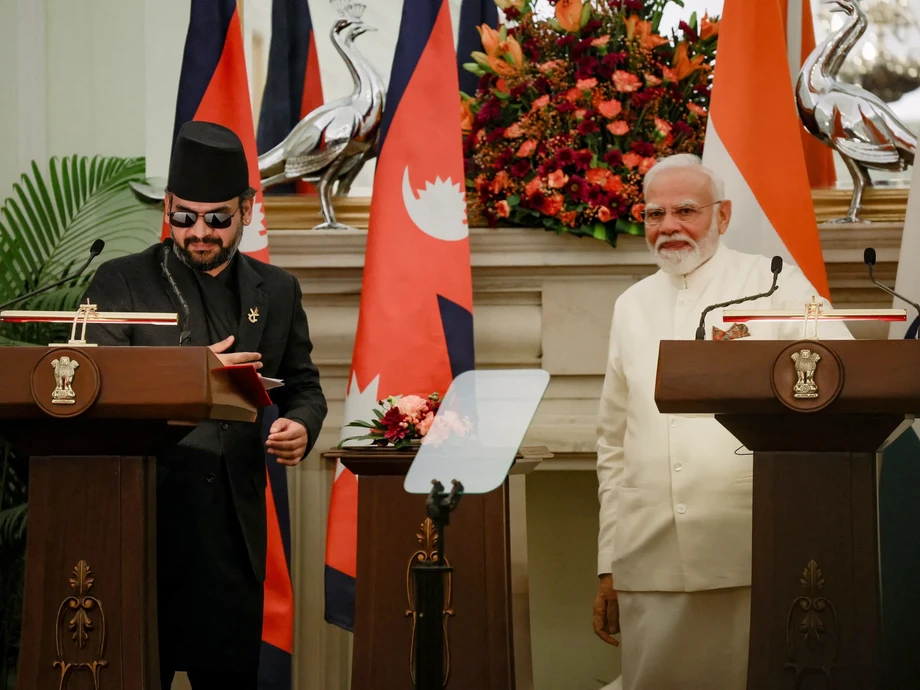
The money closed a state visit that ran from November 22 to 23, Shah's first bilateral trip abroad since he took office in March. The 36-year-old, in his familiar black attire and sunglasses, was given a guard of honour at Rashtrapati Bhavan, hugged by his 76-year-old counterpart Narendra Modi, dressed in white, and then sat with him at Hyderabad House for restricted and delegation level talks, followed by a lunch in his honour. In about 25 hours on Indian soil he also laid a wreath at Rajghat, called on President Droupadi Murmu and met external affairs minister S. Jaishankar.
By the time he left, the two governments had exchanged eight memorandums of understanding, adopted a vision document called Viksit Bharat and Samunnat Nepal: Re-imagining the Partnership, and inaugurated or begun work on a railway, a bridge, a petroleum pipeline, a hydropower plant and two border checkpoints.
What the August Floods Left Behind
On August 26 an avalanche of ice and rock near the Lhende river, on the Chinese side of the Himalaya, drove a surge of water and debris down the Bhote Koshi and Trishuli rivers into Nepal, hitting Rasuwa and Nuwakot districts hardest. The government puts the cost of rebuilding at $4.8 billion. Figures cited around the visit put the dead at more than 1,300 with more than 5,000 missing; Nepali authorities have given higher numbers, about 1,500 dead and more than 5,200 missing.
International money has been small next to the damage. In October the UN Fund for Responding to Loss and Damage set aside $20 million for Nepal, the first allocation it has made to any country and the maximum a single application can request. That is roughly one two-hundred-and-fortieth of the reconstruction bill.
Shah took the same argument to the UN General Assembly in September, his only trip abroad before this one. When climate disasters wreck poorer countries, he said, "the answer cannot simply be another mega-loan".
Modi opened his remarks in Delhi with condolences and framed the package as disaster relief as much as diplomacy. India's aim, he said, was to help affected families "get their lives back on track", create new opportunities and strengthen Nepal's capacity to deal with future disasters.
Grants, Credit and What Nepal Actually Asked For
The NPR 24,000 crore divides into NPR 5,600 crore of grant money, about Rs 3,500 crore or $377 million, for reconstruction and new infrastructure, and NPR 18,400 crore, about Rs 11,500 crore or $1.24 billion, in a line of credit for energy projects. Grants come to a little under a quarter of the total.
Nepal had asked for far more of the money as grants. Foreign minister Shishir Khanal told reporters in Kathmandu after Shah returned that Nepal had requested NPR 10,000 crore in grants and another NPR 10,000 crore in loans. Before the visit, officials had floated a $2 billion package with half of it in grants. The final deal meets a little more than half the grant request and nearly doubles the loan request.
Modi presented the numbers as part of a recovery plan.
Today, to provide fresh impetus to Nepal's reconstruction and long-term development, we are announcing a Development Cooperation Package worth 24,000 crore Nepali rupees.
Vijay Kant Karna, a former senior Nepali diplomat, described the sum as "a significant amount" that could steady a relationship that has often been uneasy.
A Credit Line Priced in Indian Rupees
Misri drew a distinction between the new credit and the money India offered after the 2015 earthquake. That facility was a $750 million line of credit in dollars, of which about $550 million had been used. The new one is the first line of credit India has extended to Nepal in its own currency.
Keep in mind the fact that that was a dollar-denominated line of credit, whereas this 11,500 crore Indian rupee line of credit will be an INR-denominated line of credit.
He said the facility was reserved for energy projects and would probably lean towards transmission infrastructure, because Nepal wants to sell far more power to India than it does now. The two countries have agreed that Nepal will eventually export 10,000 MW; current sales are about 1,200 MW. India's ambassador to Nepal and Nepal's foreign secretary will co-chair the mechanism that oversees the credit.
One Air Route Opens, the Bigger Ask Waits
The subject Nepali journalists pressed hardest before the visit was air access. Most international flights reach Nepal through Simara, south of Kathmandu, so aircraft heading for the newer airports at Bhairahawa and Pokhara from the west can be routed far out of their way, adding flying time and fuel to every landing. Nepal has asked India for extra entry points through Indian airspace, including one at high altitude near Mahendranagar, to make those airports workable for foreign airlines.
The joint press release delivered a smaller thing. The existing one way B345 route linking Kathmandu, Bhairahawa and Lucknow will be made two way, with technical consultations to settle how, and other aviation proposals left "under discussion". The high altitude western entry point is not in the document.
Govind Pokharel, a former vice-chairman of Nepal's National Planning Commission, said the change still matters for airports that have struggled since opening.
Nepal invested a huge amount of money in those airports. It fell short of expectations, but the bidirectional route is a breakthrough.
Anil Trigunayat, a veteran Indian diplomat, pointed to Indian unease about Chinese involvement in the two airports.
The airport in Pokhara can pose certain security challenges for India, so it is a more complicated issue to resolve.
Ports, a Train to Ayodhya and a Bridge at Darchula
For a landlocked country that moves most of its imports through Indian ports, the trade news was concrete. Modi said Nepal would get access to Deendayal port at Kandla in Gujarat, and to Paradip in Odisha once the infrastructure there is ready. Indian figures put India's share of Nepal's imports at more than 60 percent, worth $8.6 billion, against 13 percent, or $1.8 billion, for China.
The two prime ministers flagged off the Saryu-Kamala Express between Ayodhya, where Hindus place the birthplace of Ram, and Janakpur in Nepal, where they place the birthplace of Sita. Weekly runs begin on November 28. They inaugurated a road bridge across the Mahakali linking Dharchula in Uttarakhand with Darchula in Nepal, and laid the foundation stone of an integrated check post at Banbasa in Champawat district, while reviewing work at Bhairahawa, Sunauli and Dodhara-Chandani. The final location survey for a proposed electrified broad gauge line between Raxaul and Kathmandu is complete, and the two sides will work together on Nepal's east-west railway.
- August 26, 2026: an avalanche in Tibet sends flood water and debris down the Bhote Koshi and Trishuli, hitting Rasuwa and Nuwakot.
- September 2026: Shah addresses the UN General Assembly in New York, his first trip abroad as prime minister.
- October 2026: the UN loss and damage fund sets aside $20 million for Nepal.
- November 22 to 23: the state visit; the package, the vision document and eight agreements are announced.
- November 28: the first regular weekly runs of the Saryu-Kamala Express.
- 2027: the next India-Nepal Joint Commission meeting is due.
Rivers, Pipelines and a Project Stuck for Decades
Energy is where most of the credit will go, and the visit produced visible movement. The two leaders laid the foundation stone of the 669 MW Lower Arun hydroelectric project, pressed for completion of the Arun-3 plant on schedule, dedicated the second phase of the Motihari-Amlekhgunj pipeline and broke ground for a terminal at Jhapa with capacity for 18.9 million litres, part of a planned Siliguri-Jhapa pipeline. They also agreed to look at the possibility of gas pipelines.
Hydropower has long been the easy part of this relationship to announce and the hard part to build. The Pancheshwar multipurpose project has been discussed for decades without construction, held up by argument over its detailed project report, its costs and how benefits are split. The joint statement told the Pancheshwar Development Authority and the joint committee on water resources to finish the report quickly, and told officials to speed up work on reports for the Saptakoshi and Sunkoshi projects. Work is also under way on two big transmission lines, Inaruwa to New Purnea and Dodhara to Bareilly, through joint ventures.
Modi tied the power plans to India's market.
Friends, the rivers of Nepal have immense potential for clean energy. India's vast energy market can make these possibilities a strong foundation for Nepal's economic prosperity.
The Border Dispute Stays Off the Microphone
Neither leader mentioned the boundary dispute in public, a change from June 2023, when Pushpa Kamal Dahal stood beside Modi and raised it.
Prime Minister Modiji and I discussed the boundary matters. I urged Prime Minister Modiji to resolve the boundary matters through the established bilateral diplomatic mechanisms.
The quarrel is over Kalapani, Lipulekh and Limpiyadhura, tracts administered by India and claimed by Nepal, and it sharpened in 2020 when Kathmandu issued a revised map that included them. This time the issue appears only in the paperwork: the two leaders noted progress in joint work on the maintenance and repair of boundary pillars, and directed their foreign secretaries to work on the outstanding boundary issues.
Misri was asked whether that instruction covers the report of the Eminent Persons Group, set up in 2016 to review the whole relationship and submitted in 2018 but never formally accepted by both governments. He said the report belonged to the past.
I would say that that's in the past. We are looking at a forward-looking approach to this particular issue. We are not looking backward and to me, therefore, the report that you have mentioned is not relevant. It pertains to the past.
The vision document does promise to review the bilateral legal framework, including the 1950 Treaty of Peace and Friendship, on the basis of mutual consent. Misri said no mechanism has been chosen and that both sides would first list what they want to revisit, while conceding that the treaty, now more than 75 years old, could be looked at again with a new government in Kathmandu. Trade through the Lipulekh pass with China, which Nepal objects to, and the stalled recruitment of Gorkhas into the Indian Army under the Agnipath scheme, did not come up, he said.
Pokharel said putting the dispute off buys time that will have to be repaid.
Right now you can go home and convince the young Nepalis that it will be handled later, but if they don't deal with these issues in the future, there will be criticism.
Trigunayat said both sides seemed to prefer established channels to what he called "cartographic aggressions".
An IIT Campus, a Cricket Academy and a Nepali Language Model
The vision document ranges well beyond aid. India will set up an offshore campus of an Indian Institute of Technology in Nepal, with IIT Kanpur named as the institution to build it, alongside a startup incubator and an innovation hub, and will widen scholarships for Nepali students in law and technology in India. An agro industrial park funded by Indian grants is planned for Chitwan to process farm produce.
Modi also promised cooperation on artificial intelligence, including a large language model for Nepali, digital parks, data centres and space. The eight agreements cover satellite communications using the South Asia Satellite, through ISRO and Nepal's communications ministry; forensic science, between National Forensic Sciences University in Gandhinagar and the Crime Investigation Department of Nepal Police; police and defence training; civil service training, through the National Centre for Good Governance and the Nepal Administrative Staff College; Ayurveda and traditional medicine; urban development; health; and livestock and fisheries.
Sport got lines of its own: a national cricket coaching and training academy in Nepal, facilities at provincial level, and places for Nepali players at Indian academies. A large Nepali delegation will be invited to the WAVES summit, India's media and entertainment gathering. Both sides also agreed to make banking and telecom services easier for each other's residents.
What Has to Happen Next
A good part of the visit's output is a promise to plan. A High Level Monitoring Group led by Nepal's foreign secretary and India's ambassador to Nepal will meet at least once every six months and report to the India-Nepal Joint Commission, which the two foreign ministers co-chair and which next meets in 2027.
The aviation file returns to technicians. The Pancheshwar report goes back to a committee that has missed deadlines before, and no date has been set for finishing it. The review of the 1950 treaty has no forum yet. Modi has accepted Shah's invitation to visit Nepal, with a date to be fixed through diplomatic channels.
Shah asked Indian businesses to put money into Nepal and said the agreements had to reach the people who need them, from farmers to students to young entrepreneurs. He closed his public remarks with a line about trust.
May the friendship between Nepal and India be one where trust stands as tall as the Himalayas, cooperation flows as continuously as a river, and the prosperity of both nations flourishes beneath our shared sky.
Key Points
- India announced NPR 24,000 crore (about $1.6 billion, or Rs 15,000 crore) for Nepal, its largest ever package for Kathmandu, during Balendra Shah's visit on November 22 and 23.
- The package is NPR 5,600 crore in grants for reconstruction and infrastructure and NPR 18,400 crore in an energy line of credit, the first India has given Nepal in Indian rupees.
- Nepal had requested NPR 10,000 crore in grants and the same in loans; grants in the final deal are a little under a quarter of the total.
- The August 26 floods in Rasuwa and Nuwakot killed more than 1,300 people, with over 5,000 missing, and Nepal puts rebuilding costs at $4.8 billion.
- The Kathmandu-Bhairahawa-Lucknow air route becomes two way, but Nepal did not get the high altitude western entry point it sought for Bhairahawa and Pokhara.
- Nepal gained access to Kandla port, with Paradip to follow, and the Saryu-Kamala Express between Ayodhya and Janakpur begins weekly runs on November 28.
- Eight agreements were signed, and a vision document sets out cooperation on an IIT campus in Nepal, a cricket academy and a Nepali language model.
- The boundary dispute stayed out of public remarks but was referred to the foreign secretaries; India said the Eminent Persons Group report is not relevant.